
We tested and scored leading nursery devices across lab and home environments to show what really matters in a child’s room.
Our roundup blends objective testing data with hands-on checks of noise, ease of cleaning, and simple use. We also weigh safety notes from paediatric guidance that favour cool mist in some cases and flag burn risks.
We focus on real-world use in Singapore, where air-con can dry the air yet humidity also rises. That means control, not just gadgetry, defines value.
What we compare: humidity change, noise profile, cleaning effort, usability and safety. We preview familiar names — Levoit LV600HH, Miro NR07G, Crane Drop and Crane Adorable — because they repeatedly score well in mixed lab and home trials.
Parents reading this guide will find clear trade-offs at different budgets, plus practical notes on upkeep, mist settings and expected price ranges.
Why parents in Singapore consider a humidifier for the nursery
We explain why many Singapore families add a humidifier to a nursery and when it helps most. Air-conditioning and closed windows can make room air feel dry overnight, even in a humid climate. That dryness often shows up as blocked noses, occasional nosebleeds and itchy skin in infants.
Common dry-air triggers: congestion, nosebleeds and itchy skin
Dry room air can worsen congestion and cause skin irritation. A well-set humidifier may ease these symptoms and reduce itching during sleep. It can also reduce atopic dermatitis flare-ups that parents know all too well.
When it helps most: colds, coughs and croup support at night
We recommend using a humidifier baby setup mainly on sick nights. Moisture in the air can make nasal passages feel less dry and may help a child breathe easier during colds, coughs or croup-like episodes. It is a comfort measure, not a cure, and should sit alongside hydration and safe sleep practices.
Balancing comfort with mould and bacteria risk in humid rooms
Too much humidity invites mold, mildew and bacteria growth. Regular cleaning, emptying standing water and a hygrometer or humidistat make a big difference. Control matters: the right device and habits keep benefits while limiting microbial risk.
Warm vs cool mist for babies: what we recommend and why
Mist output should be judged on comfort and hazard, not just how quickly a room humidifies.
In simple terms, both types add moisture to the air. The key difference is risk: one raises water temperature before release and the other does not. That changes how parents should place and use a unit in a nursery.
AAP guidance on cool-mist use
The American Academy of Pediatrics prefers a cool mist device to help treat a baby’s cold symptoms. We align with that view when recommending sleeproom options.
Burn risk and safe placement rules
Devices that heat water carry a clear burn hazard if tipped or touched. Keep any such unit well out of reach, secure cords, and avoid low tables or bedside edges.
When heated-mist capability still helps at home
Heated output can be useful in adult bedrooms or living areas where burn risk is low and extra warmth is welcome. In Singapore, air-conditioning often makes adjustable output attractive, but nursery use should prioritise cool settings.
For further reading on benefits and safe use, see our detailed guide: are humidifiers good for babies.
How we compare humidifiers: the test metrics that matter
Our lab and home tests focus on four repeatable metrics that predict real-world performance. These pillars let parents map priorities — effectiveness, noise, cleaning and ease of use — to the right model.
Effectiveness: measured humidity change over time
We run each unit on high for three hours in a controlled room and log the humidity level at regular intervals. That shows how quickly a humidifier raises a room’s level and which models sustain output.
Noise: decibel tests and sound character
Noise is measured with a sound meter placed six inches from the unit on the highest setting. We record dB and describe sound quality because drips, whines or gurgles can disrupt sleep even at low levels.
Ease of cleaning: access, descaling and washability
Cleaning prevents mould and bacterial build-up. We score tanks and bases on how easily they open, whether parts are washable, and how simple descaling is in Singapore’s hard-water conditions.
Ease of use: controls, refilling and fail-safes
We judge refill process, intuitive controls, timers and auto shut-off. The best designs reduce spills and daily friction so families actually keep the unit running when needed.
These four metrics form the backbone of our recommendations. Our testing helps parents choose humidifiers by matching features to safety, sleep and upkeep needs.
What “ideal humidity level” looks like for a baby’s room
We recommend aiming for a stable indoor range of 30%–50% relative humidity. This level supports comfortable breathing and skin, while keeping microbial risk low.
Target range and mould risk
Keeping humidity below 60% is important. Exceeding this level makes rooms prone to mould and bacteria growth.
In Singapore it is easy to overshoot when windows stay closed, the weather is wet, or a unit is too large for the room.
Using a hygrometer or humidistat
We prefer devices with built-in humidistat or an external hygrometer so you see the exact humidity level rather than guessing.
More mist is not always better; steady control keeps the air comfortable without creating damp surfaces.
We will weigh built-in controls and monitoring in our picks, favouring models that keep humidity steady with minimal fuss.
Warm humidifier for baby: our top picks at a glance
To help parents buy quickly, we list four standout options that balance safety, hygiene and ease of use. Each pick highlights key strengths you can trust in a Singapore nursery: control, cleaning and quiet operation.
Best overall warm & cool mist: Levoit LV600HH
The Levoit LV600HH is a strong all-rounder. Its dual warm and cool mist modes, 1.5‑gallon tank and built‑in humidistat deliver long run time and precise control.
Why we rate it: flexible output, remote and digital display help prevent over‑humidification in any room.
Most hygienic design for frequent cleaning: Miro NR07G
Miro’s NR07G shines on hygiene. All parts are washable and the fill‑in‑place bowl makes night top‑ups quiet and neat.
Why we rate it: fully washable parts reduce bacterial risk, though it is bulkier and pricier.
Best budget value for everyday use: Crane Drop
The Crane Drop gives strong humidity output and low noise at a modest price. It performs well in small to medium rooms but has harder‑to‑reach reservoir areas.
Why we rate it: great value and quiet operation, with an easy trade‑off on cleaning effort.
Best nursery-friendly design: Crane Adorable
Crane Adorable stands out for décor and a soothing sound profile. It is quieter than many models, though less effective at raising humidity in larger spaces.
Why we rate it: child‑friendly design and gentle noise make it a good option for décor‑focused nurseries.
Best overall: Levoit LV600HH (ultrasonic warm and cool mist)
We picked the Levoit LV600HH as the model that best balances precise control with long run time and clear feedback.
Why parents appreciate its controls and display
Clear feedback matters: the built‑in humidistat, digital display and remote let us set a target and watch it hold steady. The timer and simple controls reduce guesswork during the night.
Performance and tank convenience
The 1.5‑gallon tank gives a big capacity and in our testing the unit can run up to 36 hours on low. That translates into fewer late‑night refills in an air‑conditioned room.
Noise, safety and nursery suitability
Measured under lab conditions, the unit stayed under 40 dB. That level makes it competitive for sleep spaces while the automatic shut‑off when empty adds an extra safety layer.
Cleaning and placement notes
The design includes more parts than average and a cleaning brush. That improves hygiene but requires slightly longer upkeep. The larger, heavier footprint means place the unit on a stable surface and away from cot edges and curious hands.
Most hygienic: Miro NR07G (fully washable cool-mist ultrasonic)
If hygiene and simple upkeep matter most, we recommend the Miro NR07G. This ultrasonic cool mist unit is engineered so parents can remove and wash every non-electrical piece.
Magnet assembly and “fill in place” bowl
The NR07G uses magnetic connections instead of threaded joins. That reduces awkward crevices where grime can hide.
The refillable bowl lets you top up quietly from a jug without moving the whole tank. That keeps night-time noise low and speeds routine refills.
All parts washable: why this matters
Controls sit on a separate, sealed board so all other parts are washable. We found this design helps control bacteria and stale water residue.
“Fully washable parts make deep cleaning straightforward and lower the chance of hidden build-up.”
Trade-offs to consider
- Bulky size and many parts increase storage and wash time.
- One-gallon tank supports large rooms (up to ~600 sq ft) but adds weight when filled.
- The premium price reflects hygiene-led design; it may not suit tight budgets or small shelves.
Best budget: Crane Drop (quiet, effective cool-mist option)
The Crane Drop offers a rare mix of quiet performance and strong moisture delivery at a budget price. In our tests the ultrasonic, cool mist unit produced reliable humidity output while staying below 40 dB. That combination makes it an attractive option for small nurseries and bedrooms in Singapore flats.
Why it’s a strong value
We rate this unit because it covers up to 500 sq ft with a one‑gallon tank and uses a simple dial to change output. The dial and auto shut‑off make nightly use painless when you’re tired.
Small-space fit
Compact dimensions mean the unit sits neatly on a shelf or bedside table. Place it out of reach and on a stable surface to avoid spills and reduce noise transfer.
Cleaning drawbacks and upkeep
Cleaning is the main trade‑off. Some reservoir areas are hard to reach, so consistent maintenance matters. If you skip weekly descaling, performance and hygiene can suffer.
Reducing “white dust” and practical tips
White dust comes from minerals in tap water. Using distilled water or the optional demineralisation filters cuts dust and keeps surfaces cleaner. We also recommend pairing this unit with a hygrometer so you can monitor room humidity rather than guessing.
- Pros: quiet, affordable, good output, easy dial control.
- Cons: tricky tank access, needs regular cleaning.
Cutest nursery pick: Crane Adorable (animal designs for children’s rooms)
Playful design can make a unit more likely to sit in the right place and be used every night. We found the Crane Adorable pairs a child‑friendly look with sensible safety features like auto shut‑off and optional filters.
Noise profile and bedtime use
Measured at roughly 40.2 dB, the model produces a steady, white‑noise‑like sound that many families find soothing. This trait helps it blend into bedtime routines and masks minor household sounds without being intrusive.
Effectiveness expectations
This ultrasonic cool mist unit has a one‑gallon tank and is rated for up to 500 sq ft. In our lab it trailed the top performers and may struggle in larger spaces.
Practical tip: use it in smaller rooms and monitor humidity rather than assuming advertised coverage guarantees results.
Who it suits best
The Crane Adorable suits décor‑first nurseries and compact spaces where appearance and steady use matter most. It is a sensible model when playful design encourages correct placement and nightly operation.
Upkeep note: like other ultrasonic units, regular cleaning prevents mould and residue. For more on choosing the right unit and our other picks, see our best humidifier picks.
Other notable models from the same lab comparison</h2>
Below we summarise a few additional products that appeared in our lab tests. These models can suit specific needs, but each carries trade-offs you should know before buying.
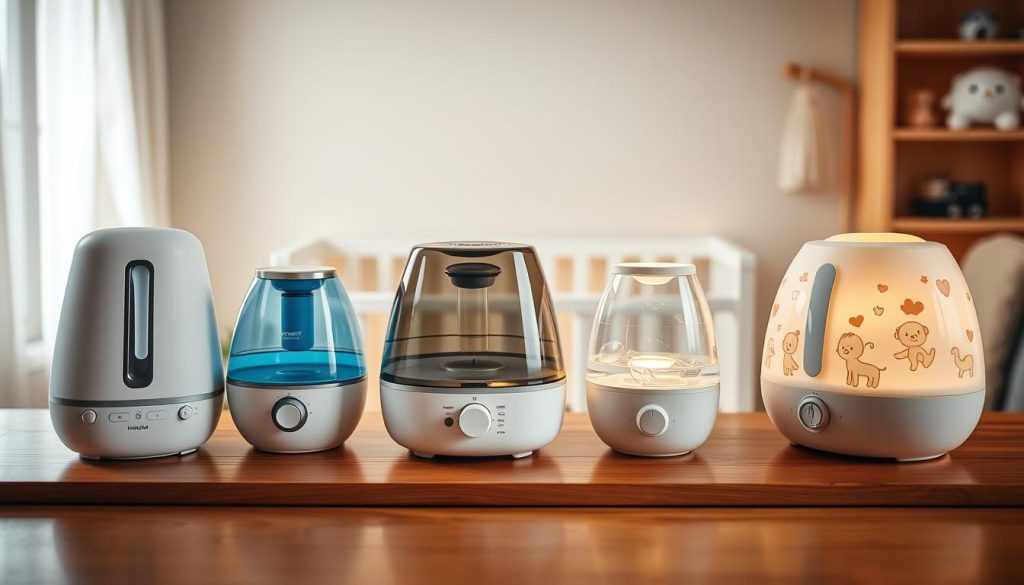
Honeywell HUL520 — compact and easier to clean, but louder
Why some parents like it: the Honeywell HUL520 has a small footprint and straightforward parts that make an easy clean routine more achievable.
Trade-offs: our noise testing recorded about 45.2 dB, and its humidity output lagged behind the top performers in the room. It is a practical option if space and cleaning ease matter most.
AquaOasis — strong output, difficult cleaning access
Key strength: this model scored highly for humidity creation and raw output in our tests.
Key drawback: the tank opening is tiny, which makes deep cleaning hard. If you favour performance, be sure you can commit to careful maintenance.
BreatheFrida — extras like a nightlight, but cleaning is fiddly
Feature-led option: BreatheFrida bundles helpful extras such as a nightlight and child-friendly modes.
Note: despite a quieter dB reading, lab notes flagged awkward parts and tricky cleaning access. Extras are useful, yet regular upkeep remains essential.
Vicks Filter Free & Pure Enrichment MistAire — budget options with limits
Both models represent common, low-cost options. Our tests show they can underperform on effectiveness, ease of use and tank design compared with higher-rated models.
Expectations: these units work as basic options, but buyers should set modest quality expectations and monitor humidity closely in the room.
Quick buying reality check: choose products that you can clean weekly. High output is useful only if the tank and parts allow routine hygiene. In our view, long-term quality depends as much on ease of cleaning as on initial testing scores.
Choosing the right humidifier size for your room and tank refills</h2>
Match a device’s coverage claim to the room you have, not the largest model you can afford. Coverage figures such as 500 sq ft (Crane), 600 sq ft (Miro) or 753 sq ft (Levoit) are useful guides. They do not guarantee results in every room.
Airflow, door position and air‑conditioning change how moisture spreads. A unit placed in a corner will perform differently to one centred on a shelf. We advise measuring the actual room and checking reported coverage as a starting point.
Tank capacity and overnight run time
Tank size translates directly to convenience. A one‑gallon tank often runs up to ~24 hours on low, while larger tanks can reach ~36 hours. For an 8–12 hour sleep window, a 1‑gallon tank usually suffices.
Plan refills: manufacturers’ “24‑hour” claims assume low output. On high settings you may refill sooner. If you need continuous moisture for longer stretches, choose higher capacity or refill mid‑day.
Placement, circulation and oversizing risks
Place the unit where air circulates freely and well above cot level. Good placement helps humidity spread evenly across the room and reduces damp spots.
- Avoid oversizing: too much output in a closed room can push humidity high and raise mould risk.
- Use a hygrometer: monitor levels rather than rely on the unit alone.
- Choose the right option: balance coverage, tank capacity and daily upkeep to fit your home and spaces.
Noise in the nursery: what to look for beyond decibels</h2>
Parents often tell us that character of sound—not just dB—dictates whether a unit stays in the nursery. Decibel readings give an objective starting point, but perceived disturbance depends on pitch, rhythm and irregular sounds.
Understanding sub-40 dB performance and perceived “white noise”
We measure noise at six inches on high; many top ultrasonic models register under 40 dB. Sub-40 dB often reads as a soft, steady hum that helps mask other household sounds.
A slightly higher dB with smooth white noise can be less annoying than a quieter high-pitched whine. That is why testers note sound character, not only level.
Placement tips to minimise drips, vibration and sleep disruption
Common nuisance sounds include dripping into the base, intermittent gurgling during refills and vibration on hollow furniture.
If a unit gets louder over time, scale build-up is a common culprit. Descale, rinse parts and check the fan or ultrasonic plate. Small changes in placement and controls can make a big difference to sleep quality for the child and the family.
Ease of cleaning and hygiene: preventing bacteria, scale and pink mould</h2>
Simple habits cut the time you spend cleaning and lower mould risk. Stagnant water in a tank or base quickly breeds bacteria and pink mould, so routine care is essential.
Daily habits
Empty the tank each morning, rinse it and wipe visible parts with a clean cloth. Let the base air-dry upside down so moisture evaporates.
Weekly deep clean
Once a week descale with white vinegar: fill the tank with a 1:1 vinegar–water mix, soak 20–30 minutes, then scrub corners with a small brush and rinse well.
Distilled versus tap water
Using distilled water reduces mineral build-up and white dust. Less scale means fewer descaling sessions and a lower chance of microbes hiding in deposits.
Design features that help
- Wide openings make scrubbing easy.
- Removable bases and washable parts speed the cleaning process.
- Detachable cords and simple seals reduce fiddly crevices for grime.
Expectation: even the best unit needs regular care. Choose models with an easy clean design to keep maintenance realistic in a Singapore home.
Safety and best practice for babies and toddlers</h2>
A safe nursery balances device placement, simple routines and realistic cleaning. We focus on practical steps that reduce tip‑overs, spills and cord hazards as infants become mobile.
Out-of-reach placement and cord management
Place the unit on a stable surface well away from cot edges. Keep cords tucked or secured so curious hands cannot pull them down.
Aim the mist so it does not dampen bedding or walls. This prevents condensation and mould risk in a small room.
Avoiding fragrances and essential oils
Do not add fragrances or essential oils. These may irritate airways. Use distilled water where possible to reduce mineral build-up and white dust.
Auto shut-off, low-water indicators and night-time checks
Choose models with auto shut-off and clear low‑water indicators. Simple controls and reliable features cut the chance of overnight problems.
On sick nights we recommend a brief night check: confirm water level, scan for condensation, and ensure humidity stays in the target range.
Value for money in Singapore: what to prioritise before you buy</h2>
Good value hinges on how a unit fits your daily routine, not only on specs. In our view, total cost of ownership matters most: purchase price, time spent cleaning, and any replacement parts or filters all add up.
Paying for features: humidistat, timers, remote controls and smart modes
Useful controls like a built-in humidistat and timers prevent over‑humidifying and cut hands‑on time. Remotes and smart modes add convenience, which can be worth the higher price when they reduce nightly fuss.
Paying for hygiene: dishwasher-safe or fully washable parts
Easy clean designs or fully washable parts (as seen on the Miro NR07G) can justify a premium. They lower the friction of maintenance so families actually keep units hygienic.
Paying for performance: humidity output that matches your space
Only pay for high output if it suits your room or spaces. An oversized model can raise mould risk in small rooms, while undersized units will run constantly.
- Prioritise: safety and reliable controls, then cleanability, then noise, then looks.
- Budget mapping: low-cost models (Crane Drop) can deliver quality output and quiet operation. Premium models (Levoit LV600HH) add features but bring more parts to clean.
- Final tip: check coverage claims against your room and consider the time you will spend on upkeep.
For an independent buying guide and more picks, see our recommended list at best humidifier options.
Conclusion
Our final takeaway is simple: steady control, easy upkeep and quiet operation win when choosing a humidifier. Prioritise a unit with reliable controls and a clear tank so you can monitor water and run time without guesswork.
For a child’s room we generally recommend cool mist; heated options increase burn risk and need careful placement out of hand reach. Aim for a stable humidity range (30%–50%) and use a hygrometer to check the humidity level.
Practical checklist: match size to the room, favour low noise for sleep, use distilled water when possible, and commit to weekly cleaning. In our testing the Levoit LV600HH suits most homes, Miro NR07G fits hygiene‑led users, and Crane Drop is a strong value option.
FAQ
Why do parents in Singapore consider a humidifier for the nursery?
When is a humidifier most helpful for colds, coughs and croup?
Should we worry about mould and bacteria when adding moisture to the nursery?
Which is safer for infants: cool‑mist or warm‑mist units?
Are there situations where a warm‑mist capability is still useful?
How do we test humidifier effectiveness?
What noise level is acceptable for a nursery?
How important is ease of cleaning and what should we look for?
What is the ideal humidity level for a baby’s room?
Should we use a humidistat or hygrometer?
Which models did we find best overall and why?
Which model is most hygienic for frequent cleaning?
What is the best budget option for everyday use?
Which design is best for décor‑minded nurseries?
What other notable models did we test?
How do we choose the right size and tank capacity?
Any tips to reduce perceived noise beyond decibel figures?
What daily and weekly cleaning habits do we recommend?
Are essential oils or fragrances safe to use?
What safety features should we prioritise?
How do we balance cost with hygiene and performance when buying in Singapore?

- Best Air Humidifier for Baby Room: Our Buying Guide - August 3, 2026
- Air Humidifier for Babies: A Comprehensive Buying Guide - August 3, 2026
- Understanding Air Humidifier Benefits for Baby: A How-To - August 1, 2026